Shared family calendar vs. a paper planner: which wins?
Paper planners feel calm and digital calendars feel powerful — but which one actually keeps a family in sync? A side-by-side comparison.
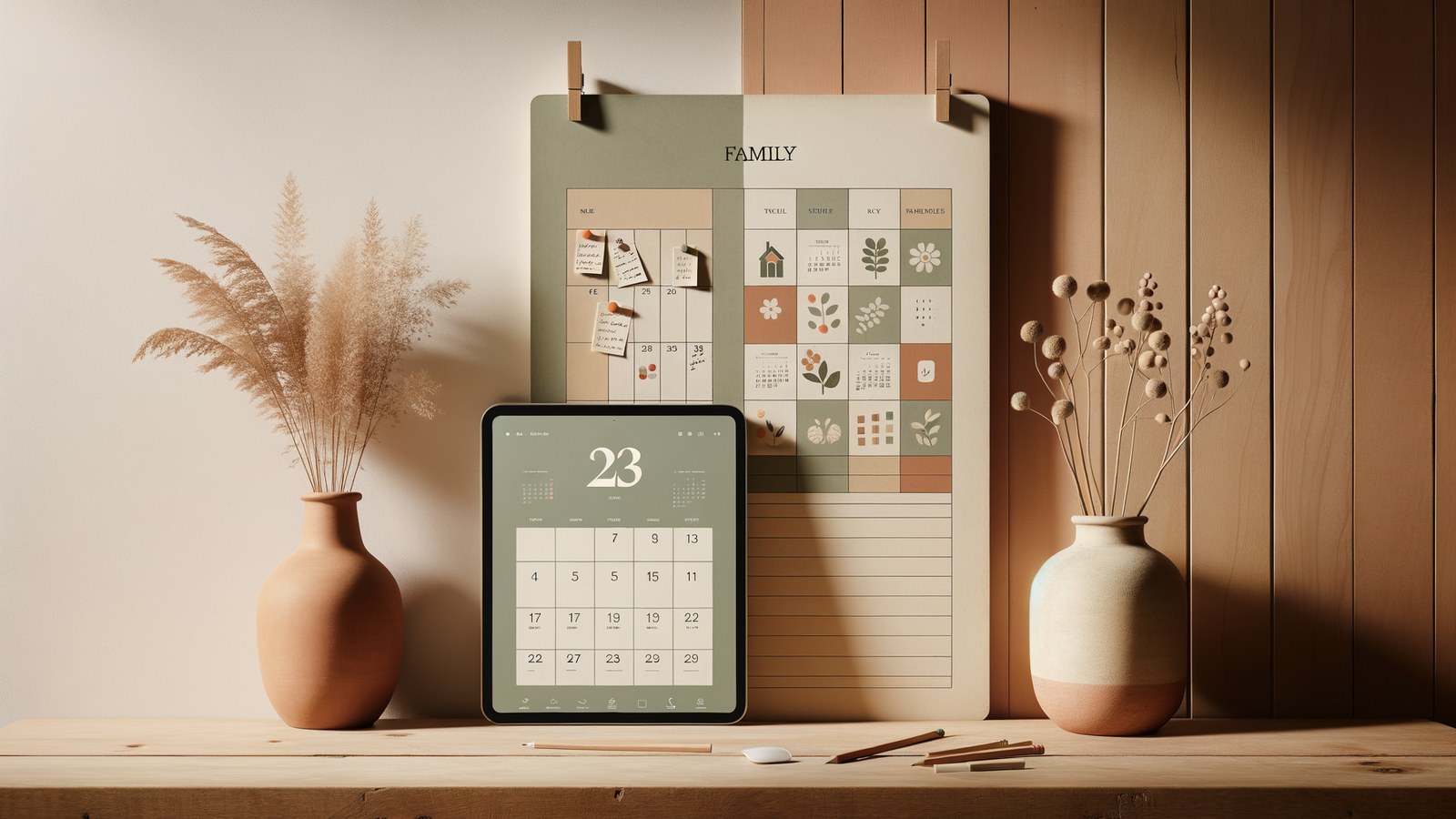
There is a small but loud camp that says digital calendars have ruined family life, and the answer is a beautiful paper planner on the kitchen wall. There is a much bigger camp that says paper is romantic nostalgia and real families need a shared family calendar on their phones. Both camps are a bit right. Here is an honest comparison of what each one actually gets you.
What paper does well
We should be fair to paper, because paper has real strengths.
A paper planner is always visible. It lives on the wall. Nobody needs to unlock a device to see it. When Emma walks through the kitchen she sees Thursday is swim night without anyone reminding her.
Paper forces deliberation. Writing an event down is slow enough that you think about whether it is actually a good idea. "Do we really need to add a third activity on Tuesday?" is a question paper asks better than any app.
No one is selling your data through paper. A wall calendar does not know your family exists.
The handwriting carries emotion. Liam's birthday written by Grandma in the September square means something a digital event never will.
Where paper breaks down
The problems are also real.
Only one person can edit at a time, and only when standing in the kitchen. If Sophie calls from the dentist's office asking when her next appointment is, the calendar is at home. Useless.
Paper does not remind you. You have to walk past it and notice. In a busy week, "noticing" is the first thing to fail.
When the week is full, it becomes unreadable. Four kids, two parents, ten activities — a paper calendar runs out of space and turns into a tangle of arrows and asterisks.
Paper does not handle repeating life. If you have a rolling pickup rotation or a 2-2-3 shift pattern, rewriting it across 52 weeks is the most boring job in the world, and half of it will be wrong by March.
If you lose the calendar, you lose the year. A dog, a toddler, a house move — and every doctor's appointment for the whole family is gone.
What a shared family calendar does well
A good digital calendar — FamilyBoard, Cozi, Apple Family Calendar, any of them — wins on the mechanics.
Everyone sees the same view, everywhere. Kitchen, car, work, grandma's house. The family's Thursday is consistent.
Entry is fast. Voice input in FamilyBoard turns "Sophie has soccer Tuesday at 5pm" into an event without any tapping.
Reminders happen automatically. The 4pm alert on swim night reaches both parents. You do not have to remember to remember.
Rolling schedules just work. Enter your co-parent pickup rotation once. The app rolls it forward automatically.
Syncing with other calendars. Work meetings, the school iCal feed, the soccer coach's booking link — they all land in the same view.
Where digital breaks down
It is invisible until you open it. A wall calendar nudges you when you walk past. A phone calendar only nudges you if it pings — and if you have muted notifications, it is silent.
Friction to enter events can be high. Ten taps to add one soccer practice kills adoption fast. (This is specifically why we built voice input — it takes the friction down to one sentence.)
Screens in the kitchen. Some families actively do not want their kids staring at a phone on the counter. Fair.
Data leaks. Not every app is private. If you care about where your family data lives, read the privacy policy before you commit.
The honest answer: use both
After talking to many families, the pattern that works best is not digital OR paper — it is digital AND paper, used for different jobs.
- The shared family calendar on your phones is the source of truth. Every event, every reminder, every rolling schedule lives there. Both parents enter events. Kids over 10 have read access.
- A small paper sheet on the fridge holds only the current week, printed or written fresh on Sunday. It is glanceable during breakfast chaos. It is not authoritative — it is a projection of the digital calendar onto paper, updated weekly.
This split gives you the calm, visible, ambient presence of paper and the coordination and reminders of digital. Neither replaces the other.
If you must pick one
For a single-parent household or one where the kids are grown: paper is fine, keep your wall calendar.
For a two-parent household with kids under 16, co-parents living apart, shift work, or more than one activity per kid: a shared family calendar app will save you three arguments a week. Pick one built for families (not a repurposed work calendar) and commit for a month.
We have written more about this in 5 mistakes families make with shared calendars and how to set up a family calendar that actually gets used — start there if you decide to go digital.
The one thing that matters more than the format
Whether you end up on paper, in an app, or a hybrid — the calendar only works if two adults enter events on it. A beautifully maintained calendar that only one parent touches is not shared. It is a to-do list with extra steps. Pick your format, sync it with your partner, and both of you commit to entering what you know.
That is the whole trick.