
Why we built FamilyBoard
A founder story about a Swedish family of five, two careers, three kids, and every family-calendar app falling short.
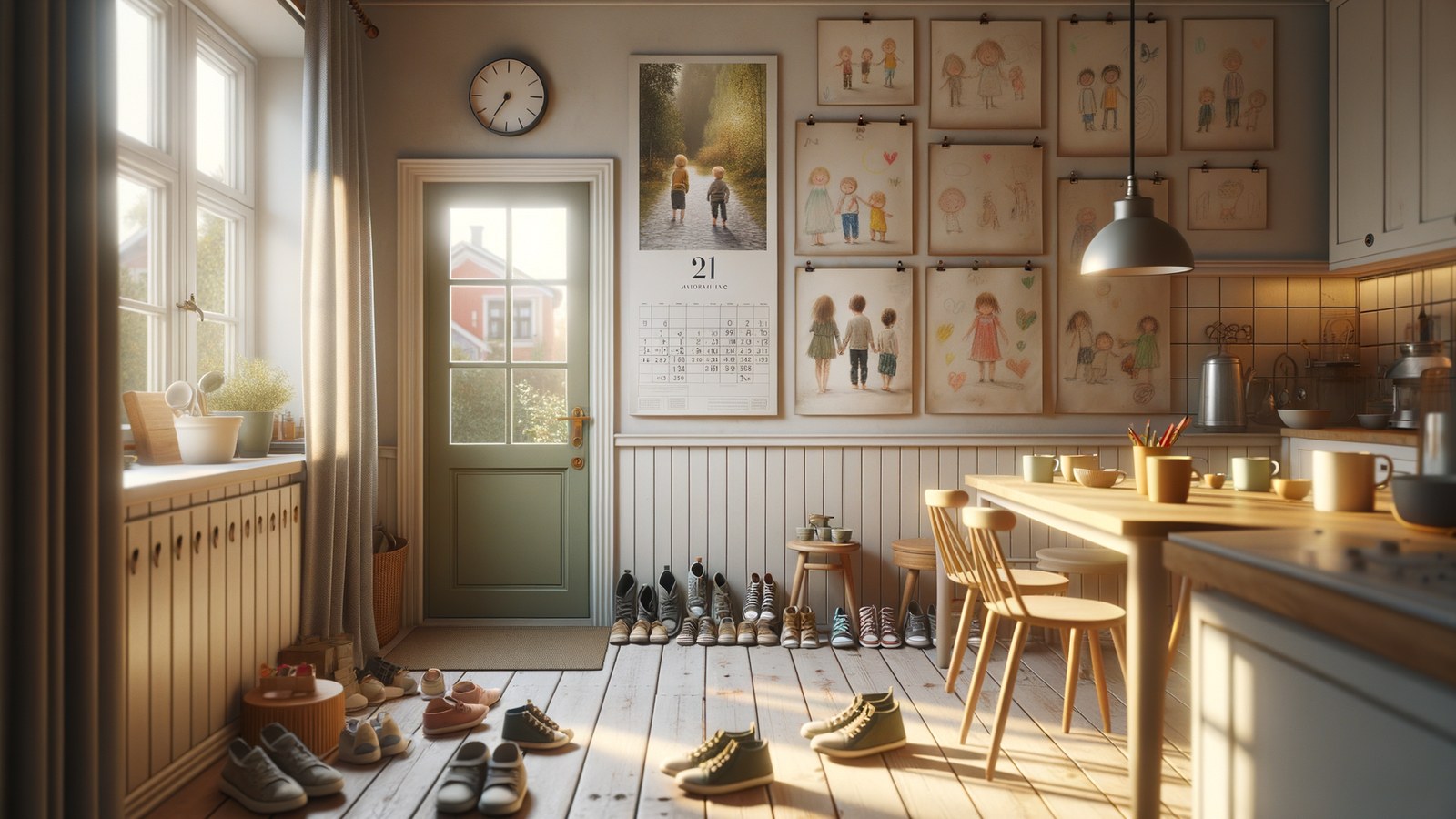
The specific moment FamilyBoard started was a Tuesday evening in Stockholm. Two adults standing in a kitchen, one of them holding a phone with Google Calendar open, the other holding a printed gymnastics schedule from the club. Three kids in three different directions for the next three days. Neither of us could quickly answer the question: "Can I say yes to a meeting at 16:00 Thursday?"
We'd tried every family-calendar app on the Swedish and European market. Cozi. TimeTree. Google Calendar with shared sub-calendars. Outlook family. A color-coded paper wall chart. A whiteboard.
Each of them got something right. None of them got the whole thing right.
What was wrong
The apps all made the same three assumptions:
- That entering an event was a non-issue. (It's the biggest issue.)
- That a calendar view is what you need. (A calendar view is one of three things you need.)
- That one-off entry is the primary workflow. (For busy families, recurring rotations are 80% of the load.)
The apps built for American families often didn't match Nordic rhythms — long summer holidays, short school weeks, the weight of the föräldramöte (parent-teacher meeting), the fritids (after-school) schedule. The apps built for couples didn't scale past two people gracefully. The generic calendars (Google, Outlook) were built for meetings, not for the question "whose turn is it to pick up from school?"
The three users we kept thinking about
We kept coming back to three people:
- A parent at a soccer practice, on a phone, with cold hands. They need to add "Emma has fridagsledig (day off) next Friday" in under five seconds. Tapping is too slow. This is the voice-input user.
- A tired parent on the couch at 9 PM. They need to see next week in one glance and know if they can accept a dinner invitation. Not scroll through a calendar — see the shape of it. This is the overview user.
- A partner at work, checking if they're needed tomorrow. They need to know in 10 seconds whether the other parent is handling pickup, or whether they should leave work early. This is the status-check user.
A single calendar grid is the wrong interface for all three. Voice input for the first. A "week shape" view for the second. A "who's doing what today" view for the third.
What we built
We started with voice. The core premise: you should be able to hold down a button, say "Oskar has fotboll Tuesday at 5 PM, I'll drive, Grandma is backup" — and have it land correctly, in Swedish, in English, or in German. That means the parser has to understand names, activities, times, and roles all in one sentence, in your language.
We layered on rolling schedules, because almost every family we talked to had some kind of rotation that didn't fit in a standard weekly calendar. Two-week pickup swaps. Every-other-weekend custody. Shift-worker rotations. A paramedic couple's 6-on-3-off cycle. A Swedish teacher couple where one had Fridays off and the other didn't.
We added a weekly AI summary because the most common complaint we heard was "I don't want to plan on Sunday, I just want to look at next week and know what I'm in for." So every Sunday evening the app sends a calm, plain-language paragraph: here's next week, here are the two tight spots, here's what's unscheduled.
What we refused to build
We said no to a lot of things.
- No ads. A family calendar is too intimate to carry ads. We charge for the product.
- No social feed. The calendar isn't a timeline for feelings. It's operational.
- No gamification. We don't give kids points for going to piano. That's a bizarre incentive.
- No public sharing. Your family's schedule doesn't go on the internet. Ever.
- No third-party data access beyond what's required for the app to work. We don't sell to insurance companies, schools, or anyone else.
A family calendar has access to where your children are, when. That's an unusual responsibility. We've tried to take it seriously in the architecture — minimal data retention, encryption where it matters, and a straight answer to "who sees this?" (You, your partner, anyone you explicitly invite. Nobody else. Not us.)
The founder backstory, since you asked
My partner and I have three kids and two careers. She's a designer. I'm an engineer. We've lived in Stockholm for over a decade. Our oldest plays hockey, our middle one does theater, our youngest is still young enough that "activity" mostly means "I want a snack." We're the family this is being built for. We were the first beta users, still are.
The failure mode we were trying to avoid, from the start, was the one where the calendar becomes a part-time job. A good family calendar disappears into the background. It's the opposite of engaging. If you're opening the app dozens of times a day, we've failed.
We're small. We'll stay small. We want to build one really good thing, for a specific kind of family, and we want that family to look up from their week and feel slightly less frantic than they used to.
That's it. That's the pitch. If you're in that family, welcome.